
- Arrive and pull out the bags and flags.
- Take 1 bag and banner to the respective ground’s location.
- Each Bag contains: 6 Cones, 2 Batting Tees, 3 Blast Cricket Balls, 2 Bats. 2 Pairs of Stumps.
- Team Managers take the bag and setup the field
- Once the game is over, managers pack the equipment into the bag and bring the bag and banner back to the clubhouse.
- Blasters Co-Ordinator will then pack up the kit.
- Any issues, please contact the Co-Ordinator on the day.
Wet Weather
Decisions about weather to call off the day, will be made by 3.30pm so that parents can co-ordinate alternative plans for the evening. Blast Skills parents will be notified by message directly. Blasters Managers will be notified and then the managers will let their teams know.
Blaster Game
Games should run from 60 to 90 minutes.
Each innings lasts 12 overs.
Teams that have more then 6 players should make sure that each player gets to bat/bowl equal number of balls/overs as each other.
If a fielding team has less then 6 players, then the batting manager can play as the wicket keeper.
If a bowler does not have the ability/strength to bowl the full length of the pitch, they can bowl closer to the batter, with managers making sure everyone stays safe. Its more important that they bowl with a straight arm, and the balls are hittable by the batting team.
Game Setup
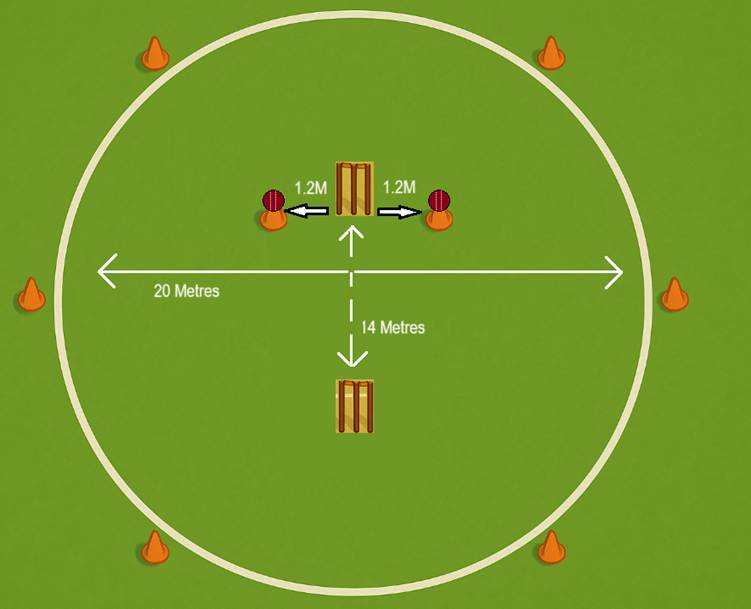
Put the 6 cones evenly around the field, around 20 – 30m.
Put stumps around 14m apart in the middle of the cones.
Put free hit tees 1.2 – 1.5m on either side of the batting crease at one end.
Put 1 Ball on each Tee for free hits.
Bowlers bowl next to the stumps at the bowlers’ end.
Game Rules
Bowling and Fielding
All overs are bowled from the same end.
After each over, the fielding team rotates in a circular formation to ensure an equal turn in each position.
No fielder is allowed within 10m of the bat until the ball is hit.
“No balls” and “wides” are not re-bowled.
A no ball or wide is deemed to be any ball that is either:
- Dangerous
- Above waist high on the full
- Bounces above shoulder height
- Cannot be hit because it is too wide or bounced too many times/rolling.
Following a no ball or a wide, the batter receives a “free hit” from the tee. The batter must hit the ball forwards off the tee.
If a bowler does not have the ability/strength to bowl the full length of the pitch, they can bowl closer to the batter, with managers making sure everyone stays safe. Its more important that they bowl with a straight arm, and the balls are hittable by the batting team.
Batting
Players bat in pairs for 4 overs.
Batters swap ends when dismissed and at end of the over.
Batters swap ends if a batter faces 3 balls in a row.
Umpires should use discretion to swap batters to ensure each batter faces approximately 12 balls each.
No Leg Before Wicket (when the ball strikes the batter in-line with hitting the stumps).
Manager Game Duties
Fielding team’s manager stands behind the stumps at the bowler’s end.
They are responsible for:
- Call of wides, no balls
- Instructing their bowlers on bowling with a straight arm
- Rotating the fielders promptly.
- Batter and player safety.
Batting Teams Manager Stands square of the wicket.
They are responsible for:
- Putting the balls back on the teas for free hits.
- Making sure that batter does not hit the ball backwards off the free hit.
- Batter and player safety.
- Being the wicket keeper if fielding team has less than 6 players.